Search

Wang Yangming – Green Bamboo
The Strongest “Slasher” Sage in History, the God of War Who Awakened to the Universe’s Vitality on the Brink of Death
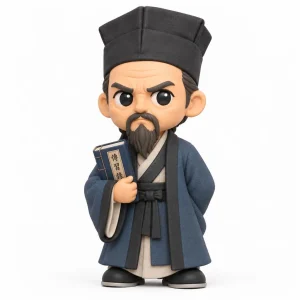
Resilient as Bamboo, Conscience & Action
Character Introduction and Historical Background
Wang Yangming (born Wang Shouren) lived in China during the mid-Ming Dynasty in the 15th and 16th centuries. If you think philosophers are all frail scholars who can’t even truss a chicken, Wang Yangming will absolutely subvert your perception. He was not only a top-tier scholar but also an ever-victorious military genius. While suffering from severe tuberculosis, relying only on a temporarily assembled ragtag army, he suppressed the world-shaking “Prince of Ning rebellion” in just 35 days.
His life was full of dramatic entanglements with “wood.” In his youth, to pursue the Confucian truth of “investigating things to extend knowledge” (Gewu Zhizhi), he stared at the bamboo in his courtyard for seven days and seven nights (historically known as “Shouren Investigating Bamboo”), attempting to see through the operating principles of the universe from the bamboo. As a result, he saw nothing, but instead made himself gravely ill, coughing up blood.
Later, because he offended the eunuch Liu Jin, he was demoted and exiled to the miasma-filled Longchang in Guizhou. In that barren wilderness haunted by the threat of death, he lived in a stone cave and pondered day and night. Finally, late one night, it was as if he were struck by lightning, and he attained a great awakening—it turned out that the truth was never in the bamboo outside, but within the human mind. This is the famous “Longchang Enlightenment” in the history of Chinese thought.
Core Philosophy and Metaphors
The core question Wang Yangming explored was: “Since pursuing material things and knowledge outwardly cannot make us sages, where should we go to find the ultimate truth of life?”
His core philosophy is the “School of Mind” (Xinxue), and we can use the growth of a “tree” to perfectly understand its three main pillars:
- Nothing exists outside the mind (The Seed of All Things): He believed that external bamboo and flowers lose their meaning if they are not perceived by your consciousness. The seed of truth has long been buried in the field of your mind.
- Extension of Innate Knowledge (Internal Watering): Everyone is born with “innate knowledge/conscience” (Liangzhi) to distinguish right from wrong, good from evil. Innate knowledge is like a seedling; you do not need to go outside to find other people’s leaves to stick on yourself. You only need to listen to your heart and reflect on yourself every day, watering this seedling, and it will naturally grow into a towering tree.
- Unity of Knowledge and Action (Unity of Roots and Leaves): This is his most shocking viewpoint. He believed that “to know but not to act is equivalent to not knowing.” Just like a tree, “knowledge” is the root buried deep underground, and “action” is the branches and leaves breaking through the soil. Leaves without roots will wither (blind action), and roots without leaves will rot (empty theory). True knowledge and action are two sides of the same tree.
Representative Works and Famous Quotes
His disciples compiled his quotations and letters into the immortal masterpiece Instructions for Practical Living (Chuanxi Lu). This book has influenced countless generations; even Japanese Bushido and the Meiji Restoration were deeply inspired by Yangming’s School of Mind.
Besides the “unity of knowledge and action,” his most deeply moving sentence was his last words before death:
“This heart is radiant with light; what further words are needed!”
(此心光明,亦復何言!)
In 1529 AD, the 57-year-old Wang Yangming lay on his sickbed after returning from suppressing a rebellion. His students tearfully asked if he had any last words. He smiled slightly, left behind these eight Chinese characters, and passed away. His life was like a towering tree that remained standing tall despite storms and lightning, always growing in accordance with his inner conscience, leaving behind absolutely no regrets.
Modern Inspiration
In modern society, we face severe “information anxiety” and “procrastination.” We have saved hundreds of articles on “how to succeed” or “how to be self-disciplined” on our phones, which is like desperately sticking leaves from other people’s trees onto ourselves. But because they have not taken root, a single gust of wind blows them all away.
Wang Yangming’s “unity of knowledge and action” is a specific cure for modern procrastination. He pointedly reminds us: if you have read 100 books on fitness but have never gone for a single run, then you are “ignorant” about fitness. True knowledge grows out of the pain and sweat of action.
At the same time, in an era full of external judgments, his “extension of innate knowledge” tells us: do not look outside for validation. As long as you take root inwardly and are convinced that what you are doing is right, you can be like a resilient green bamboo. No matter the raging storms of the outside world, you can still hold fast to your original heart and stand unyielding.