Search

Hobbes – Iron Chains
The Cold-Eyed Prophet Born Twin to Fear, the Order-Maker Who Ended the Slaughter of All Against All in the Name of Leviathan
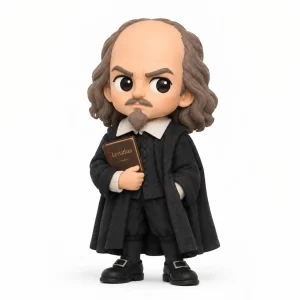
Cold as Iron, Contract & Suppression
Character Introduction and Historical Background
Thomas Hobbes lived in turbulent 16th- and 17th-century England. He was born in 1588 during the massive invasion of England by the Spanish Armada, a period when his mother was seized by such extreme panic that she gave birth prematurely. Hobbes later wrote with a humorous and chilling composure: “My mother gave birth to twins: myself and fear.”
He lived through the bloodiest and most volatile era in English history: the outbreak of the English Civil War, the public execution of King Charles I, the brutal mutual slaughter of the Roundheads and Royalists, and the total dissolution of social order.
Faced with fanatical religious factions and warlord divisions, Hobbes was forced into exile in France for eleven years. During his exile in Paris, watching his compatriots bleed to death in lawless slaughter, he resolved to use a cold, materialistic, geometric approach to deduce the sole solution for humanity to escape mutual destruction. When Leviathan was published, it simultaneously enraged the Royalists (who felt he undermined the divine right of kings) and the Papacy (which accused him of being an atheistic monster). Yet, this masterpiece born of fear thoroughly rewrote the foundational logic of modern political philosophy.
Core Philosophy and Metaphors
The core question Hobbes explored was: “If we lose the coercive jurisdiction of the state and the law, where will human nature head? How can humanity completely escape the nightmare of violent death?”
He introduced mechanical materialism into sociology, proposing the world-shaking concepts of “Leviathan” and “Social Contract”:
- The State of Nature: A War of All Against All (Beasts Tearing at Each Other): Hobbes stripped away all romantic illusions about the “inherent goodness of human nature.” In a state of nature without the restraint of a powerful public authority, human beings fall into an endless quagmire of mutual harm for survival, honor, and selfish interests. In this state, the strong can be ambushed and assassinated by the weak at any moment; there are no true winners, and every person’s life is “solitary, poor, nasty, brutish, and short.”
- Fear Stimulates Reason (The Birth of Leviathan): Extreme terror of a “violent, sudden death” prompts the awakening of reason within humanity. To save their own lives, people decide to enter into a contract, surrendering the right of arbitrary violence and self-defense entirely to an “artificial giant (Leviathan)” constructed of law and monopolized violence—namely, the supreme sovereign state.
- The Metaphor of the Iron Chain of Order and Security: The laws, institutions, and punishments of a state are like cold, heavy “iron chains.” Everyone hands over their wild freedom of wanton harm to lock everyone simultaneously into the cage of order. It appears to be a constraint, but it is precisely this icy iron chain that fiercely chokes the beast within every human heart, ensuring that people no longer need to carry knives at all times to guard against a neighbor’s backstabbing.
Representative Works and Famous Quotes
His magnum opus is Leviathan, alongside the philosophical treatise De Cive (On the Citizen) which explores civic duties.
When mentioning Hobbes, these blunt and cold famous quotes remain chilling to this day:
“During the time men live without a common Power to keep them all in awe, they are in that condition which is called War; and such a war, as is of every man, against every man.”
Peace is not a natural gift of nature, but a fragile balance forcibly maintained by humanity through harsh institutions. Once order collapses, the veneer of civilization turns to ash in seconds.
“Covenants, without the sword, are but words and of no strength to secure a man at all.”
Moral appeals and good intentions carry zero binding power. If any rule lacks the iron-fisted sanction of an enforcement agency as its backing, it can ultimately never prevent betrayal and wrongdoing.
Modern Inspiration
In our modern society—where we are accustomed to peace and stability and easily fall into the illusion that “civilization is a given”—Hobbes’s alarm bell of the “iron chain” will never go out of style.
We often take orderly traffic, fair contractual guarantees, and the safety of walking down the street at night as naturally as air, while complaining about the red tape of the system. Hobbes would coldly point out: the worst order is infinitely superior to the freest anarchic chaos.
Examining today’s fractured international landscape, geopolitical conflicts, and extreme turbulence, you will find that the darkness of human nature has never evolved. Knowing how to revere the boundaries of order, cherishing the constraints of institutions and laws, and understanding that “security” is the absolute prerequisite for all freedom and development—this is the most sober survival antidote Hobbes left for every modern individual.