Search

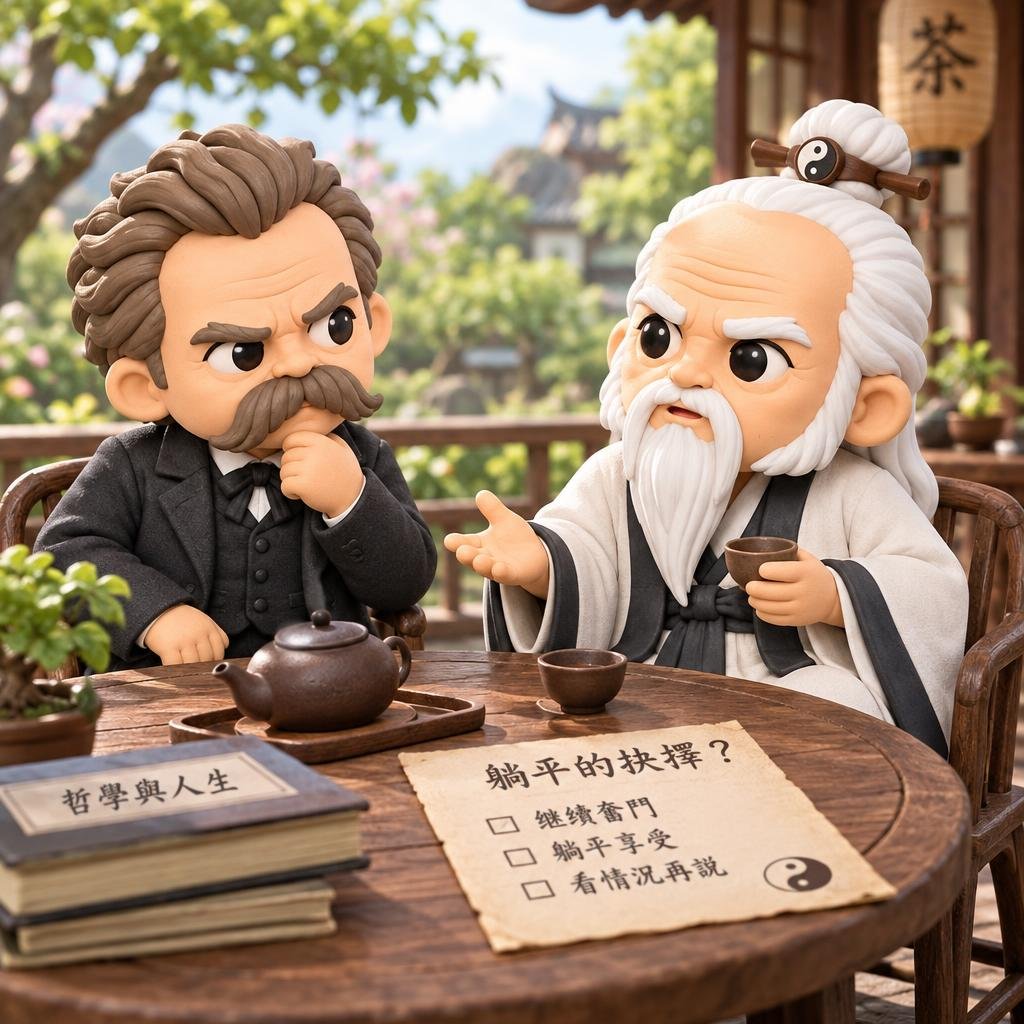

The fast pace of modern society and the severe phenomenon of “involution” (neijuan) have led to the rapid spread of “lying flat” (tang ping) and a “low-desire society” among the younger generation. Faced with high living costs, heavy work pressure, and insurmountable class barriers, many young people choose to abandon traditional secular competition, actively lowering their material desires to maintain a basic life at the lowest possible cost. Is this ultimately passive self-abandonment, or a silent protest against the tide of the times? We can deconstruct this profound modern phenomenon through the perspectives of ancient and modern philosophers.
Laozi: The “Wu Wei” (Non-Action) of Following Nature
The Eastern philosopher Laozi would likely have immense empathy and resonance with the “lying flat” of modern youth. His core philosophy is built upon “governing by doing nothing” (wu wei er zhi) and “having few desires” (shao si gua yu).
- Returning to Original Simplicity: In Laozi’s eyes, modern society’s endless overtime, excessive competition, and fanatical pursuit of material wealth are all “forced actions” (you wei) that go against the laws of nature. This societal pathology destructively consumes human vitality.
- Contentment Brings Happiness: The “lying flat” youth’s decision to give up buying cars and houses and to reject overwork echoes the wisdom of the Tao Te Ching: “He who is contented suffers no disgrace; he who knows when to stop is free from danger.” Only by knowing when to stop can one avoid falling into danger and collapse.
- Not Passive Decadence: However, the “wu wei” in Laozi’s philosophy is not about completely giving up and waiting to die, but rather “acting without contending” (wei er bu zheng). This means finding true inner peace and the authentic essence of life without blindly following societal frameworks.
Nietzsche: The “Übermensch” (Superman) Rebelling Against Nihilism
In stark contrast to Laozi’s transcendent retreat, the modern Western philosopher Friedrich Nietzsche would offer the harshest critique and challenge to “lying flat.”
- The Last Man Phenomenon: Nietzsche would view youths who have completely lost their desires and drive as “The Last Man” (der letzte Mensch) from his writings. The Last Man seeks only comfort, fears pain, and has no pursuits; this is the ultimate symbol of the human spirit heading towards mediocrity and degeneration.
- Will to Power: Nietzsche advocates the “Will to Power” (Wille zur Macht). He believes that the essence of life lies not in merely scraping by, but in continuous self-transcendence and overcoming difficulties.
- Embracing Fate: Faced with a high-pressure and seemingly hopeless society, Nietzsche’s solution is definitely not to lie down. He advocates “Amor Fati” (Love of Fate)—facing and embracing the pain in life, transforming into the “Übermensch” amidst despairing nihilism to create entirely new values for oneself.
Philosophical Divide and Advice for Modern People
Laozi and Nietzsche hold diametrically opposed views on “lying flat”: Laozi sees it as a survival wisdom of shedding vanity and returning to natural tranquility, whereas Nietzsche sees it as a passive nihilism that surrenders one’s life potential to compromise with reality.
Advice for Modern People: We do not need to lean extremely to either side. When facing an uncontrollable external macro-environment, you can draw from Laozi’s “wu wei”—letting go of excessive anxiety and unrealistic social comparisons, and learning to give yourself a break. However, when facing your personal inner life, you should ignite Nietzsche’s “Will to Power” and refuse to let your soul wither. Seek what you love within the micro-world you can control, and create your own localized meaning.

Which life philosophy do you lean towards more?
All articles and images on this website are original works by the author and are copyrighted. Without permission, please do not arbitrarily reproduce, copy, or use for commercial purposes; if you wish to reproduce, please [contact this site] in advance to obtain authorization.
Disclaimer: The content of this article is for academic discussion, ideological exchange, and reference purposes only. The philosophical views mentioned herein do not represent the stance of this website or its authors, nor do they constitute any psychological, financial, or life coaching advice. Readers are solely responsible for their own choices and lifestyles. This website and its owners shall not be held liable for any direct or indirect consequences arising from reading this article.