Search



In recent years, artificial intelligence (AI) and robotics have experienced explosive growth. From traditional factory assembly lines to drawing, programming, legal analysis, and even medical diagnosis, AI is sweeping across major industries at an unprecedented speed. Many professions once considered exclusive to humans are gradually being replaced by algorithms and robotic arms. This rapid transformation has triggered widespread societal anxiety: when “work” is no longer the sole pillar for human survival and social identity, are we ushering in a complete liberation from heavy labor, or are we falling into a disorienting spiritual crisis? The thoughts of the ancient Greek philosopher Aristotle and the modern Western absurdist philosopher Albert Camus can help us untangle this modern dilemma.
Aristotle: Liberation from Labor and the Pursuit of the Highest Good
The core of ancient Greek philosopher Aristotle’s thought is built upon “Teleology” (Telos) and the pursuit of “Happiness” (Eudaimonia, defined as the soul living and actualizing in accordance with virtue).
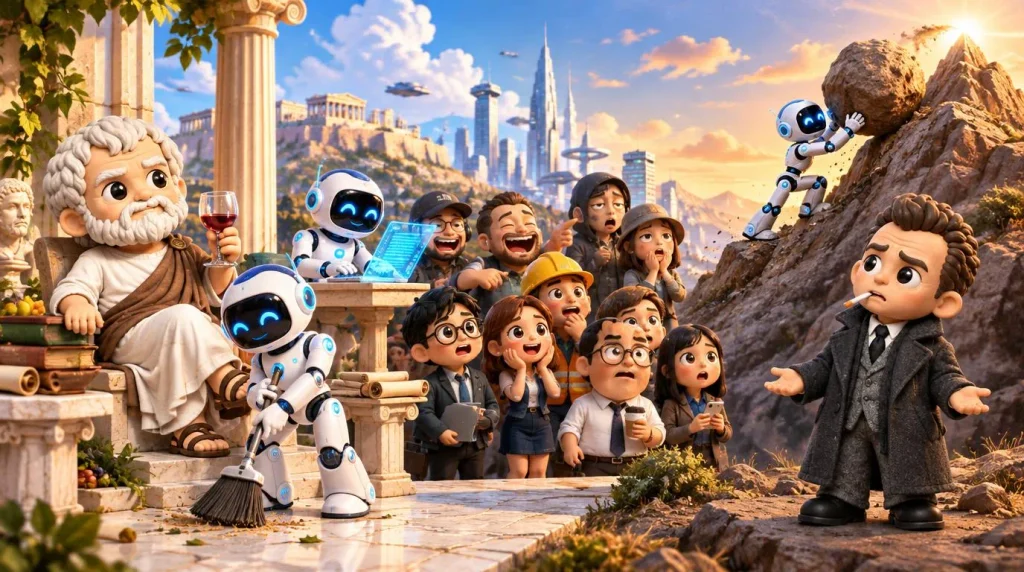
- The Vision of Automated Tools: In his Politics, Aristotle made a famous prophecy: if every tool could perform its work automatically upon command or anticipation—like a plectrum plucking a lyre or a shuttle weaving a web by itself—then masters would no longer need slaves, and managers would no longer need workers.
- Labor as a Means, Not an End: In Aristotle’s view, physical and repetitive labor performed to maintain material existence is not the highest purpose of life itself, but a restriction one has to endure. The ultimate goal of labor is to attain “Leisure.”
- Embracing AI’s Spiritual Liberation: Facing the wave of AI and robotics replacing jobs, Aristotle would view it as a major advancement in human civilization. When AI takes over the physical and tedious mental labor required to keep society running, humanity is finally freed from the shackles of survival. This liberation gives us the opportunity to invest our precious time in higher-order rational activities—engaging in philosophical contemplation, artistic creation, moral practice, and participation in public affairs—thereby truly realizing the “highest good” of life.
Albert Camus: The Absurd Confrontation of Losing the Boulder
In contrast to Aristotle’s optimistic expectations, the Absurdism of 20th-century Western philosopher Albert Camus offers a profound warning.
- The Myth of Sisyphus: Camus used the Greek myth of Sisyphus as a metaphor for the human condition: Sisyphus was punished by the gods to push a giant boulder to the top of a mountain, only for it to roll back down each time he reached the summit, forcing him to repeat this meaningless labor day after day. Camus argued that modern occupational labor is precisely this repetitive and absurd process. Yet, it is exactly during the process of lucidly facing this meaninglessness and persisting in pushing the boulder that Sisyphus demonstrates a rebellion against fate and the dignity of individual existence.
- The Spiritual Void of Being Stripped of the “Boulder”: When AI and robotics take over all professions, it is equivalent to machines replacing Sisyphus in pushing the boulder up the mountain, or even taking over the entire boulder-pushing process. Camus would question: when humans lose the “boulder” (work and survival pressure) they must confront and bear every day, do we simultaneously lose the daily stage and territory for establishing our sense of existence and willpower?
- Rebellion Against Emptiness: The price of AI replacement might be plunging humans into an unprecedented “existential void.” Camus reminds us that the pain of losing labor does not equal the attainment of freedom. Without the practice of confronting the absurd, humanity will only drift toward spiritual withering and emptiness in a state of idle comfort.
Philosophical Divergence and Conclusion
Aristotle’s and Camus’s outlooks on “AI replacing jobs” form a stark contrast:
- Aristotle views labor as a means, believing that AI replacing jobs is an opportunity to unleash humanity’s rational potential and pursue lofty spiritual values.
- Camus, however, focuses on the sense of existence behind labor, worrying that after AI takes away humanity’s “boulder,” people will face a misplaced sense of absurdity and emptiness.
Advice for Modern Individuals:
In the face of AI’s rapid development, we need not panic excessively over the disappearance of professions, nor should we blindly sink into despair. We can draw upon Aristotle’s wisdom, actively utilizing AI as an assisting tool to liberate ourselves from repetitive tasks and explore higher levels of spiritual nourishment and knowledge. At the same time, we must bear in mind Camus’s warning: in an era where we do not need to scramble desperately for survival, we must actively seek out and construct our own “boulder”—whether it is a passion for creation, unique personal experiences, or care for others—proactively endowing our lives with unique meaning in a future devoid of compulsory work.
All articles and images on this website are original works by the author and are copyrighted. Without permission, please do not arbitrarily reproduce, copy, or use for commercial purposes; if you wish to reproduce, please [contact this site] in advance to obtain authorization.
Disclaimer: The content of this article is for academic discussion, ideological exchange, and reference purposes only. The philosophical views mentioned herein do not represent the position of this website or the author, nor do they constitute any career planning, psychological counseling, or investment advice. Readers should be solely responsible for their own choices and lifestyles. This website and its owner bear no responsibility for any direct or indirect consequences arising from reading this article.