Search

Seneca – Anvil
The Stoic Titan in the Vortex of Imperial Power, the Roman Mentor Who Forged an Unyielding Soul on the Anvil of Fate
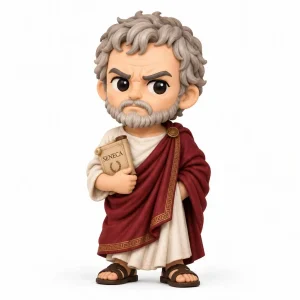
Resilient as Anvil, Refinement & Composure
Character Introduction and Historical Background
Seneca the Younger (Latin: Lucius Annaeus Seneca minor, c. 4 BC – AD 65) is the most famous Stoic philosopher, playwright, and statesman of the ancient Roman Empire. Born in Corduba (modern-day Córdoba, Spain), he received a top-tier education in rhetoric and philosophy in Rome during his youth.
Seneca’s life was filled with extremely dramatic storms and tension. He was exiled to a barren island for eight years due to political struggles; later, he was dramatically recalled to Rome to serve as the imperial tutor and chief advisor to the tyrannical young emperor Nero. At the center of power, he attempted to guide and restrain Nero using Stoic philosophy, but ultimately was powerless to turn the tide, watching helplessly as Nero grew increasingly cruel. When Nero finally ordered his death, the great philosopher showed no tears or fear; instead, he calmly severed his arteries and faced death with composure. Through his own life, he perfectly demonstrated what it means to “maintain absolute freedom of the soul in the face of power and death.”
Core Philosophy and Metaphors
The core question Seneca explored was: “Facing a world full of turmoil, betrayal, and impermanence, how should we control our minds and live with dignity and tranquility?”
His thoughts constitute the practical peak of Stoicism in Rome:
- Premeditation of Evils (Premeditatio Malorum): The Stoics believed that most people’s suffering stems from blind optimism and a fear of fate. Seneca advocated conducting a “mental rehearsal” every morning, imagining the worst-case scenarios happening in your mind (such as poverty, exile, disease, or death). When you become accustomed to the worst possible outcomes in advance, the blows of reality can no longer shake you.
- Adversity as Refinement: Seneca believed that the hardships of fate and tyranny are like a hammer, constantly striking us. But for the strong, setbacks are not destruction, but a necessary process to forge and temper the soul.
- The Metaphor of the “Anvil”: Seneca’s philosophy and mindset are like an “anvil” that endures countless heavy blows yet never shatters. The external world brings raging storms, regime changes, and the iron hammers of fate (such as Nero’s tyranny) crashing down relentlessly, but the anvil itself not only remains undamaged, it becomes even more resilient with every strike. It absorbs all the pain and blows of fate completely, revealing the supreme composure and strength of the soul through this tempering process.
Representative Works and Famous Quotes
His masterpieces passed down through the ages include the collection of letters Letters from a Stoic (Epistulae Morales ad Lucilium) and the collection of short essays On the Shortness of Life.
When mentioning Seneca, these classic quotes—piercing through fear—serve as the strongest spiritual armor when facing adversity:
“We are more often frightened than hurt; and we suffer more from imagination than in reality.”
(Latin: “Diusque nos opinio torquet quam res; nec illa quae nos torquent vera sunt, sed aestimamus illa.”)
The vast majority of life’s anxieties are self-inflicted scares. Fear itself is often more destructive than the actual disaster.
“Fire tests gold, hardship tests strong men.”
(Latin: “Ignis aurum probat, miseria fortes viros.”)
Adversity and tribulations are not punishments from heaven, but the best anvil upon which to polish your mind and will.
“If one does not know to which port one is sailing, no wind is favorable.”
(Latin: “Ignoranti quem portum petat nullus ventus suus est.”)
If life lacks clear principles and goals, you can only let the winds and waves of fate push you into confusion.
Modern Inspiration
In our modern era—a time of high pressure, “involution” (hyper-competition), and sudden crises (such as economic fluctuations, workplace layoffs, and social anxiety)—Seneca’s “anvil” philosophy is a highly effective tranquilizer.
When you panic over sudden bad news or fall into anxiety about the future, Seneca would firmly tell you, like an anvil: do not dodge hardship; treat it as a tool to forge yourself.
He reminds us that while we cannot dictate our external environment or the heavy blows of fate, we can decide whether we shatter easily like glass or grow stronger under the blows like an anvil. Withstand the wind and waves, treat every setback as a tempering process, and live out absolute inner peace amidst the hammer blows of life.