Search

Buddha – Void
The Runaway Crown Prince Who Forsook the Throne, the Spiritual Anatomist Who Saw Through Attachment Under the Bodhi Tree
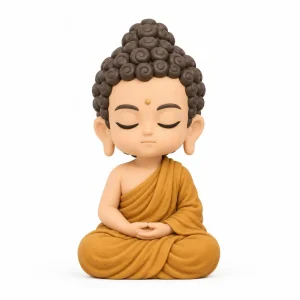
Vast as Void, Breaking Attachments & Nirvana
Character Introduction and Historical Background
Shakyamuni (Siddhartha Gautama, Sanskrit: सिद्धार्थ गौतम) lived in ancient India during the 6th to 5th centuries BC. Born in the Shakya Republic (Kapilavastu), he was a crown prince of the Shakya clan who enjoyed all the worldly wealth, glory, and luxuries imaginable.
His turning point stemmed from the soul-shaking “Four Sights” outside the four gates of his palace: he witnessed firsthand the decay of an old man, the wailing of a sick man, the rotting corpse of a dead man, and the tranquility of an ascetic. His magnificent palace instantly turned into a prison, and the ultimate human predicament of birth, aging, illness, and death became a lingering nightmare.
Deep in the night at the age of twenty-nine, he abandoned his throne, his wife, and his newborn son, shaved his head, stripped off his royal garments, and walked barefoot into the wilderness. He endured six years of extreme asceticism, surviving on a single grain of rice or a drop of water a day, becoming emaciated to skin and bones with sunken eyes. Yet, he discovered that torturing the physical body could not bring wisdom. Ultimately, he abandoned asceticism, washed away his filth in the Nairanjana River, accepted an offering of milk-rice from a young village girl, and walked to a Bodhi tree. Sitting cross-legged, he vowed, “Even if my flesh and bones wither and decay, I shall not rise from this seat until I attain supreme enlightenment.” Finally, as the morning star rose at dawn, he achieved complete awakening.
Core Philosophy and Metaphors
The core question Shakyamuni explored was: “Where exactly does human suffering come from? How can we sever this endless cycle of pain?”
He was not a creator god who made the world, but rather a calm psychologist and physician of the soul. His philosophical framework is constituted by the “Four Noble Truths” (Suffering, Origin, Cessation, and Path), with the core lying in shattering the obsession with the self:
- Dependent Origination, Emptiness, and No-Self (Anatta): Nothing in the world is eternal, unchanging, or independently existent (Impermanence). The “I” that we view as our core is merely a temporary amalgamation of the Five Aggregates: form, feeling, perception, mental formations, and consciousness. The root of suffering (the Origin) stems precisely from our desperate clinging to this illusory “I,” which thereby breeds the endless cravings of greed, anger, and ignorance.
- The Metaphor of the “Void” (Emptiness/Space): Shakyamuni compared the awakened mind to the boundless “void.” Storms and lightning can rage through the void, and dark clouds can gather within it, but the void itself is never tainted by the storm, nor is it diminished in the slightest by the clouds. Ordinary people cling to every single cloud (emotions, fame, wealth, gains, and losses), and thus suffer from anxiety over keeping or losing them; an awakened one recognizes that their true nature is like the void itself. Letting all things come and go, arise and cease, their mind remains eternally vast, all-embracing, unhindered, and unattached.
- The Raft for Crossing the River: He warned his disciples never to treat his teachings as dogmatic idols: “My teachings are like a bamboo raft used to cross a river. Once you reach the other shore, you should leave it behind and continue your journey. Would you still carry the raft on your back to travel on dry land?”
Representative Works and Famous Quotes
Like many ancient masters, Shakyamuni did not write down his teachings during his lifetime. After his passing, his teachings were compiled and recited by five hundred disciples, recorded in the vast Agamas and later Mahayana sutras such as the Diamond Sutra and the Heart Sutra.
When speaking of Shakyamuni, these eternally resonant quotes best embody his piercing insight into the essence of all things:
“As stars, a fault of vision, as a lamp, a mockery, dew drops, or a bubble, a dream, a lightning flash, or cloud, so should one view all that is conditioned.”
(一切有為法,如夢幻泡影,如露亦如電,應作如是觀。 — The Diamond Sutra)
All conditioned phenomena in the world, stitched together by causes and conditions, are like a dream, a bubble in water, an illusory reflection, or like morning dew and a flash of lightning across the night sky—fleeting and transient. Only by seeing clearly the nature of impermanence can the mind stop being led by the nose by gains and losses.
“Matter is emptiness, emptiness is matter. Matter is not other than emptiness, emptiness is not other than matter. The same is true for feelings, perceptions, mental formations, and consciousness.”
(色不異空,空不異色,色即是空,空即是色,受想行識,亦復如是。 — The Heart Sutra)
This is the most famous core philosophy of the Heart Sutra. “Matter” (Form) represents the physical world, while “Emptiness” represents the absence of any fixed, unchanging, independent entity. Matter and emptiness are not opposites; the essence of everything in the phenomenal world (matter) is emptiness, and emptiness must also manifest through a myriad of ever-changing phenomena (matter).
Modern Inspiration
In our modern era—an age hijacked by algorithms, fear-based marketing, appearance anxiety, and wealth rankings—Shakyamuni’s wisdom of the “void” acts as the most profound cooling balm.
We live every day in severe “internal mental friction,” terrified of aging, terrified of falling behind, terrified of losing everything we currently have. Shakyamuni would gently remind you: do not attempt to grasp a gust of wind or a cloud.
Acknowledge that the base canvas of life includes suffering. Learn to detach yourself into the perspective of an “observer,” quietly watching your anxiety, anger, and greed gather and disperse like clouds and smoke, without identifying with them or clinging to them. Expand the capacity of your mind to be like the void. Let the external storms and gales howl as they pass through, while you internally guard a realm of unattached, unhindered clarity and absolute ease.